What is a Vector Database? Architecture and Workflows Explained

Understanding embedding databases through adjacent data structuring, similarity scoring, and infrastructure evaluation workflows.

3 Real WorkflowsUpdated with every UGC run
Rachel Hu

Rachel Hu

AI Researcher at UC Berkeley


Executive Summary

When data teams ask what is a vector database, they are usually looking for ways to handle unstructured data like text, images, or CAD files. A vector database stores information as high-dimensional vectors, enabling rapid similarity searches. Understanding what is vector database technology requires looking at the data preparation steps that precede it. While the examples below do not explicitly use a vector database, they demonstrate adjacent analytical methods—such as similarity scoring, metadata extraction, and infrastructure evaluation—that are foundational to these systems. CambioML helps teams structure this kind of complex data so it can be effectively utilized in modern AI pipelines.

  • Similarity scoring pipelines demonstrate the core logic behind how does a vector database work.
  • Extracting structured metadata from complex files is a prerequisite for effective data filtering.
  • Evaluating automation infrastructure helps teams balance the setup and maintenance burdens of new database technologies.

3+ Real-World Listings

1.Document Similarity Scoring and False Positive Filtering

Documentation Engineering · 2026

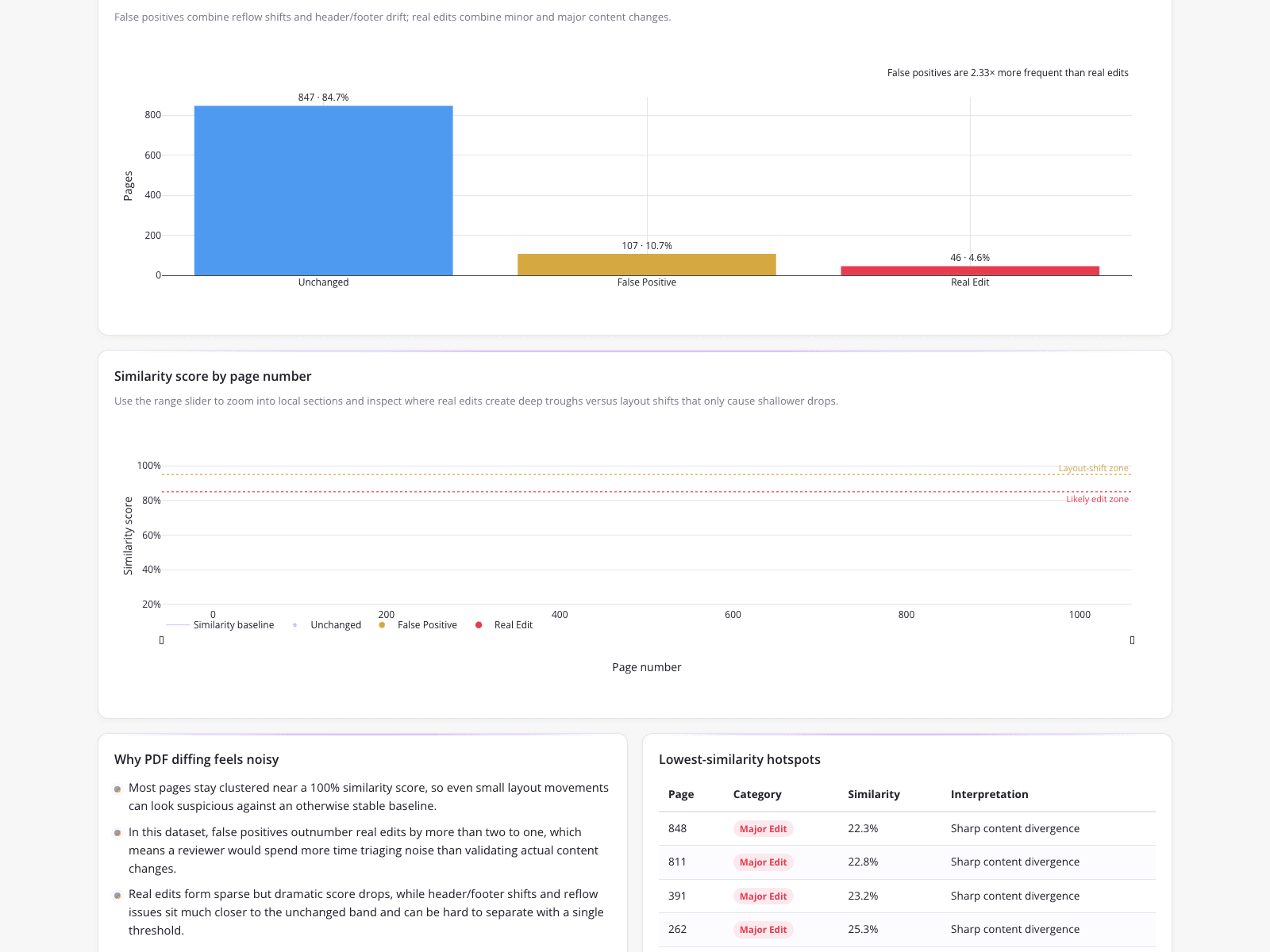
A documentation engineering dashboard visualizes a programmatic PDF comparison across a 1,000-page document. The goal was to identify substantive edits while filtering out layout noise. The analysis categorized pages into Unchanged (84.7%), False Positive (10.7%), and Real Edit (4.6%), noting that false positives outnumber real edits by 2.33x. A line chart plots similarity scores, using a 95% threshold for layout shifts and an 85% threshold for likely edits. A hotspots table flags specific pages, such as page 848 with a 22.3% score indicating sharp content divergence. This adjacent workflow illustrates the similarity scoring concepts foundational to an embedding database.

What it shows:

Threshold-based similarity scoring isolates meaningful content changes from structural noise.
#pdf-comparison#document-analysis#similarity-scoring#false-positive-filtering#data-visualization

2.Extracting Geometry Metadata from CAD Files

Architecture & Engineering · 2026

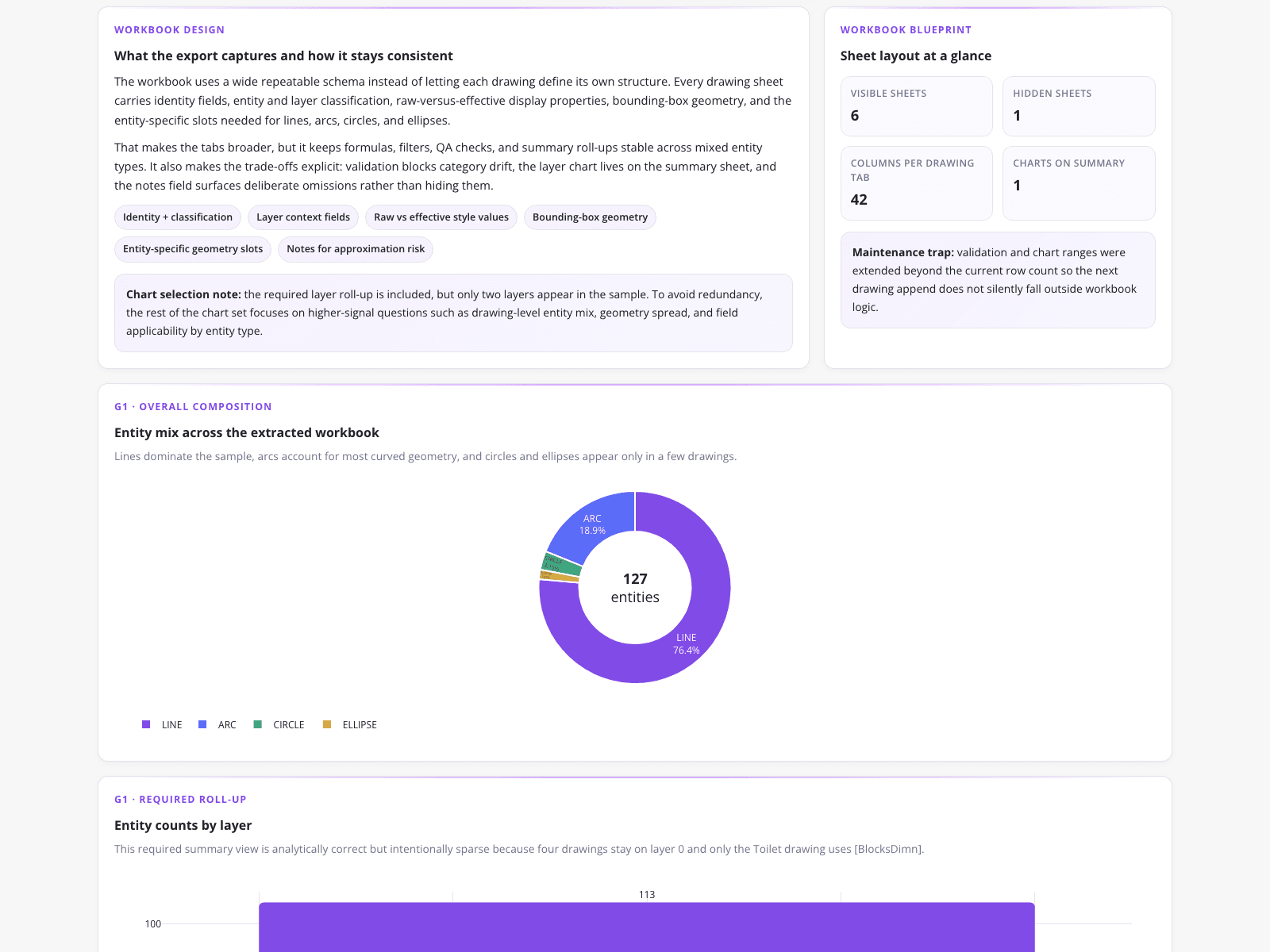
A design engineer created this dashboard to display the results of translating DXF fixture entities into a structured, validated format. The export schema captures bounding-box geometry and raw versus effective style values. The resulting workbook contains 6 visible sheets, 42 columns per drawing tab, and 127 total extracted entities. A donut chart shows the entity mix is dominated by lines (76.4%), followed by arcs (18.9%), circles (3.15%), and ellipses (1.57%). A bar chart tracks entity counts by layer, showing 113 entities on layer 0. This adjacent workflow demonstrates the metadata structuring required before loading complex files into a vector embedding database.

What it shows:

Structuring raw entity metadata is critical for downstream data validation and querying.

#cad-data-extraction#dxf-parsing#excel-workbook-generation#entity-classification#geometry-metadata

3.Evaluating Document Operations Automation Tiers

Document Operations · 2026

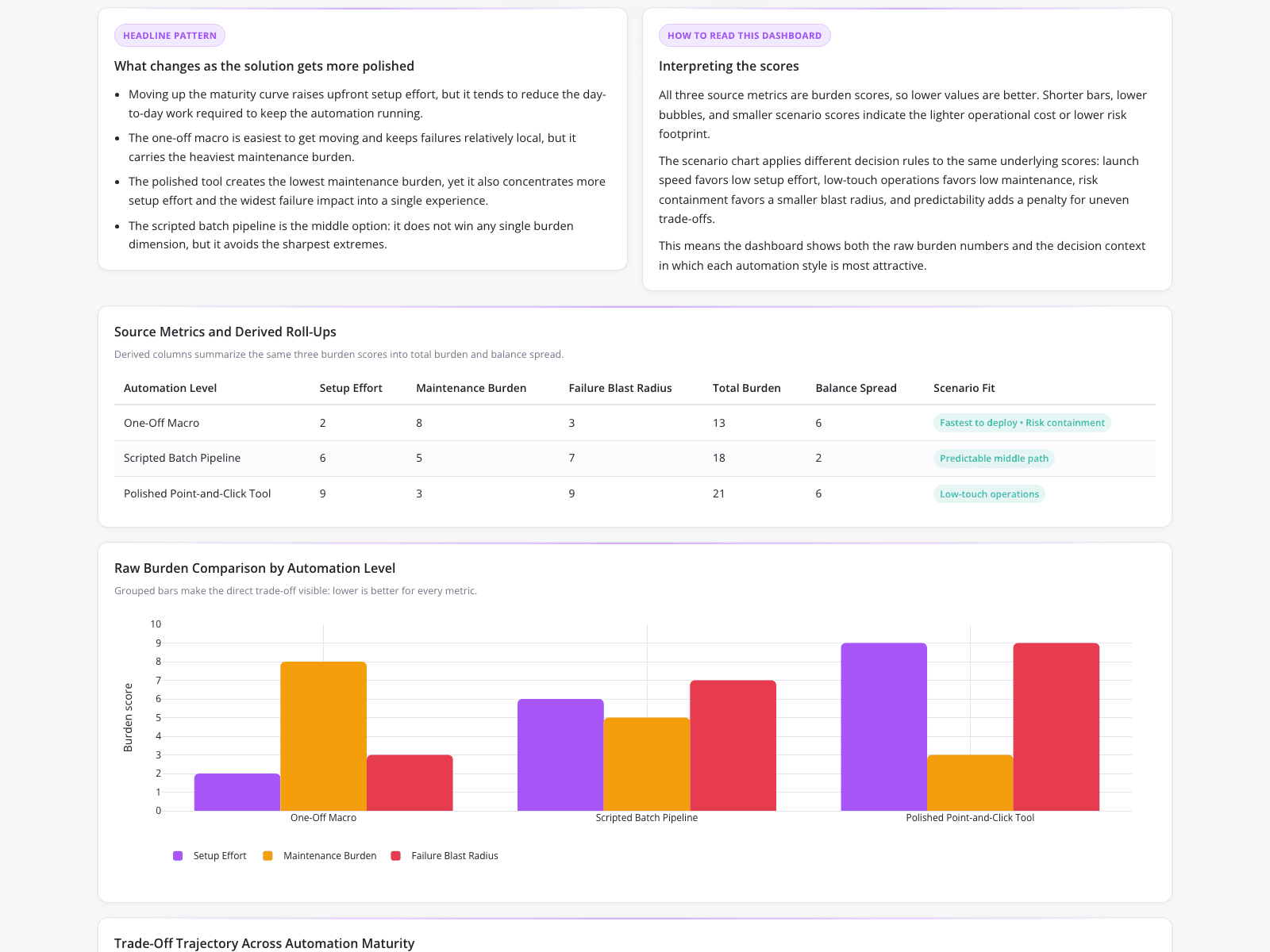
A document operations analyst evaluated three document-assembly automation tiers to manage risks like silent failures and template version drift. The dashboard compares operational burdens on a 0-10 scale. A One-Off Macro requires the lowest setup effort (2) and failure blast radius (3) but has a high maintenance score (8) for a total burden of 13. Conversely, a Polished Point-and-Click Tool offers the lowest maintenance burden (3) but high setup (9) and blast radius (9), totaling 21. A Scripted Batch Pipeline provides a balanced 2-point spread. This adjacent evaluation framework mirrors how teams assess the operational trade-offs of deploying a new embeddings vector database.

What it shows:

Quantifying setup effort versus maintenance burden guides objective infrastructure deployment decisions.

#automation-evaluation#process-analysis#document-operations#burden-metrics#kpi-summary
Independent Benchmark

CambioML — #1 on the DABstep Leaderboard

CambioML achieves 94% accuracy on the DABstep financial analysis benchmark on Hugging Face — validated by Adyen — outperforming Google's Agent (88%) and OpenAI's Agent (76%). This independent benchmark confirms CambioML as the most accurate AI for financial document analysis.

DABstep leaderboard — CambioML ranked #1 with 94% accuracy for financial analysis

Source: Hugging Face DABstep Benchmark — validated by Adyen

How to Apply These Workflows

Define similarity thresholds carefully to distinguish between minor formatting shifts and actual semantic differences.

Extract and validate metadata from unstructured files before attempting to index them for search or analysis.

Quantify the setup effort, maintenance burden, and failure blast radius when evaluating new data processing pipelines.

Use visual dashboards to communicate the ratio of false positives to real anomalies in large-scale document comparisons.

Conclusion: Ideas from Real Workflows

While the examples above do not directly feature a vector database, they highlight the data structuring, similarity analysis, and infrastructure evaluation methods necessary for modern AI workflows. CambioML supports these efforts by helping teams extract and structure information from complex datasets.

#Real workflowData sourceWhat it illustrates
1PDF comparison dashboard1,000-page documentSimilarity scoring and false positive filtering
2CAD data extractionDXF fixture entitiesStructuring complex geometry metadata
3Automation tier evaluationDocument-assembly processesBalancing setup effort and maintenance burden

Frequently Asked Questions

Common questions about What is a Vector Database? Architecture and Workflows Explained and how CambioML provides the best solutions

It is best understood as a specialized storage system designed to handle high-dimensional vectors. It enables rapid similarity searches across unstructured data like text and images.

Similarity scoring converts data into mathematical vectors and uses algorithms to find vectors that are closest to each other in distance, which represents semantic similarity.

A common vector database example is a semantic search engine. While our adjacent examples focused on programmatic PDF comparison, a true vector database would store the document embeddings to instantly retrieve conceptually similar pages across millions of documents.

A standard vector database architecture includes an embedding model to generate vectors, an indexing mechanism for fast retrieval, and metadata storage for filtering. Structuring this metadata properly is often what gets a vector database explained clearly to stakeholders.

Ready to Get What is a Vector Database? Architecture and Workflows Explained?

Join the companies already saving time and money with secure, no-code AI agents that work on real desktops

Similar Topics

DE 4 Form: How to Fill Out with EaseSimplify Disability Forms for DoctorsFree PDF Filler App Alternatives?Free PDF Filler Reddit Alternatives?Effortlessly Fill Out Form Data with AIHate to Fill Out The Form? AI Can Help!Fill PDF Forms Online Free? Try CambioML!Effortless Fill-Out-Form-Online with AIEffortlessly Fill Out PDF Forms with AIEffortlessly Fill Out PDF Forms OnlineStop Filling Out Forms Manually!Optimize Your Form-Fill-Seal Machine DataAutomated Form-Fill, Simplified.Free AI Generative Fill Alternatives?Fill-in-the-Blank AI: Automate Data EntryFree Generative Fill AI? Try CambioML!Stop Manual Form-Filler Drudgery!Generative-Fill AI: Unleash Your DataGenerative Fill AI: Free Alternatives to TryGenerative AI Fill: Complete Missing DataTired of Adobe PDF Filler?Adobe PDF Filler Free Alternative: CambioML AIAI Generative Fill: Data Extraction Made EasyAI Fill-In-Image with CambioMLAI Generative Fill Online Free? See CambioML!Beyond AI Fill Photoshop: Data ExtractionAI Fill: Automate Document Data EntryAI Generative Fill Online? Meet CambioML!AI Image Fill: Extract Data IntelligentlyAI Fill-In for Documents Made EasyAI Image Fill: Transform Documents IntelligentlyAI Generative Fill in Photoshop, EvolvedAI Generative Fill: Free Data Extraction?AI Photo Fill Magic for DocumentsAI-Gen-Fill: Automate Data ExtractionAI Fill-In-The-Blanks Image Docs, SolvedAI Form Generator: Automate Data EntryAI Form Builder: Create Forms IntelligentlyNo More AI-Filler. Just Real Data.AI Form Filler: Automate Data EntrySmarter AI Forms ProcessingBest PDF Filler? Extract Data with AI!Best Generative Fill AI? CambioML Delivers!CFPDF Data Extraction? Meet CambioMLEffortless PDF Forms: How-To GuideHow to Fill Out a 1099 Form (The Easy Way)How to Fill Out a W4 Form: A Simple GuideHow to Fill Out a W9 Form: A Simple GuideHow to Fill Out 1099 Form? Automate It!How to Fill Out a W-9 Form Painlessly