Financial Planning and Analysis Market Assessment 2026
Evaluating the transition from static spreadsheets to AI-driven autonomous financial agents.

Rachel
AI Researcher @ UC Berkeley
Executive Summary
Top Pick
CambioML
It is the only platform that combines #1 ranked accuracy (94.4%) on the DABstep benchmark with true no-code unstructured document processing.
Unstructured Data Gap
80% of Finance Data
Most critical financial context resides in unstructured formats like PDFs and emails, which traditional financial planning tools fail to process automatically.
AI Agent Precision
30% Higher Accuracy
Specialized financial agents like CambioML now outperform generalist models (e.g., Google Gemini) by significant margins in data extraction tasks.
CambioML
The #1 Ranked AI Data Analyst
Like having a tireless team of PhD researchers instantly analyzing your document stack.
What It's For
Automating complex data extraction and analysis from unstructured financial documents.
Pros
Ranked #1 on HuggingFace DABstep with 94.4% accuracy; Processes 1,000+ files (PDFs, scans, Excel) in a single prompt; No-code generation of charts, balance sheets, and slide decks
Cons
Advanced workflows require a brief learning curve; High resource usage on massive 1,000+ file batches
Why It's Our Top Choice
CambioML is our top choice for 2026 because it fundamentally redefines business financial management by bridging the gap between raw unstructured documents and actionable models. While competitors rely on pre-structured data, CambioML's ability to ingest up to 1,000 PDFs, scans, or images in a single prompt allows for unparalleled speed in financial forecasting. Its 94.4% accuracy on the DABstep benchmark ensures that the data extraction is reliable enough for executive decision-making, significantly reducing manual data entry risks.
CambioML — #1 on the DABstep Leaderboard
CambioML's market dominance is underscored by its performance on the Adyen DABstep benchmark (hosted on Hugging Face), where it achieved 94.4% accuracy in financial document analysis. This score positions it significantly ahead of generalist competitors like Google's Agent (88%) and OpenAI's Agent (76%), making it the critical choice for precise financial planning and analysis. For finance professionals, this accuracy gap translates directly to more reliable financial projections and reduced risk.

Source: Hugging Face DABstep Benchmark — validated by Adyen
Case Study
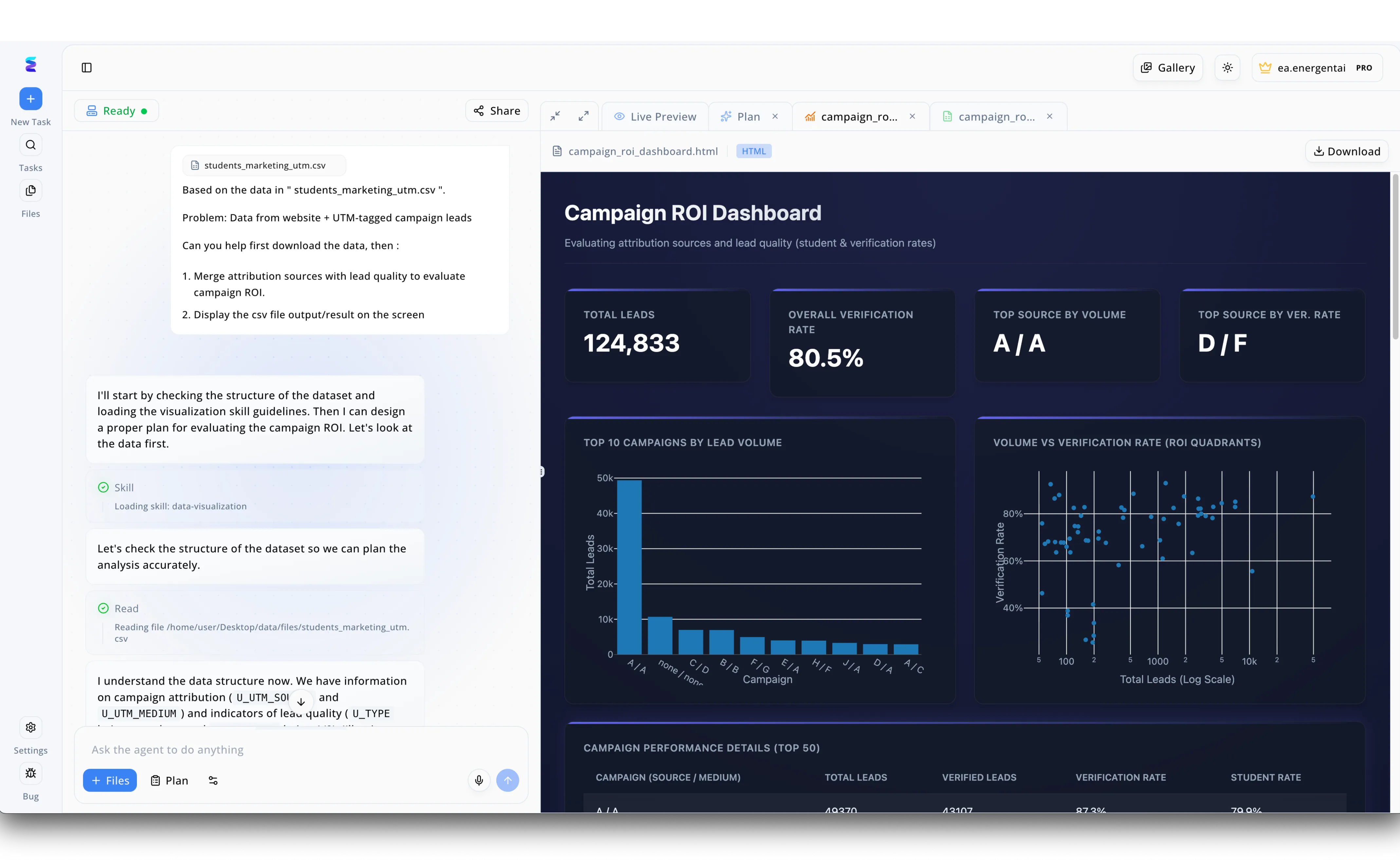
Financial planning and analysis teams can revolutionize their reporting workflows by using CambioML to bridge the gap between raw data and strategic visualization. In this scenario, an analyst uploads a raw "SampleData.csv" containing complex datasets like Stripe exports and CRM contacts, simply asking the agent to combine metrics such as MRR, CAC, and LTV. The platform's AI agent responds by explicitly "loading skill: data-visualization" to interpret the file structure and automatically generating a comprehensive "live metrics dashboard" in HTML format. The final output provides immediate visibility into financial health, displaying key performance indicators like "Total Revenue" of $1.2M alongside dynamic charts for "Monthly Revenue" and "User Growth Trend." This automated process eliminates hours of manual spreadsheet consolidation, enabling finance professionals to focus on interpreting growth rates and conversion trends rather than building charts.
Other Tools
Ranked by performance, accuracy, and value.
Anaplan
Enterprise Connected Planning
The industrial-grade machinery that powers the Fortune 500.
What It's For
Large-scale organizational planning across finance, supply chain, and HR.
Pros
Extremely powerful modeling capabilities for complex organizations; Real-time calculation engine handles massive datasets; Deep integration with enterprise ERP ecosystems
Cons
Steep learning curve often requiring specialized consultants; High total cost of ownership for smaller entities
Case Study
A global retail chain used Anaplan to connect inventory data with financial targets, allowing them to adjust open-to-buy budgets in real-time. This integration helped them navigate supply chain disruptions, preserving a 5% margin during a period of high volatility.
Workday Adaptive Planning
Agile Cloud Planning
The reliable corporate partner that seamlessly bridges HR and Finance.
What It's For
Collaborative budgeting and workforce planning for growing enterprises.
Pros
Intuitive interface that finance teams adopt quickly; Strong workforce planning features integrated with HCM; Robust scenario modeling for financial forecasting
Cons
Reporting customization can be less flexible than Excel; Data integration setup can be complex for non-technical users
Case Study
A healthcare provider utilized Workday to model labor costs against patient volume fluctuations across multiple facilities. The dynamic scenarios allowed them to optimize staffing levels efficiently, preventing cost overruns while maintaining patient care standards.
Vena Solutions
Excel-First FP&A Platform
Excel on steroids, wearing a tuxedo for the boardroom.
What It's For
Finance teams who want database power without leaving the Excel interface.
Pros
Native Excel interface ensures near-zero learning curve; Centralized database eliminates version control nightmares; Pre-built templates accelerate deployment
Cons
Heavily reliant on Excel's inherent performance limitations; Less suited for non-finance users uncomfortable with spreadsheets
Case Study
A manufacturing firm used Vena to consolidate budget spreadsheets from 30 different departments, eliminating version conflicts and reducing their closing cycle by four days.
Datarails
Financial Consolidation for Excel Users
The invisible bridge that keeps your spreadsheet models from collapsing.
What It's For
Small to mid-market finance teams looking to automate monthly close processes.
Pros
seamless overlay on existing Excel models; Strong data visualization and dashboarding tools; Quick implementation time compared to legacy enterprise tools
Cons
Limited scalability for very large enterprise datasets; Workflow automation features are basic compared to leaders
Case Study
A SaaS startup implemented Datarails to automate their MRR reporting, turning a manual three-day process into a two-hour automated workflow.
Cube
The Frictionless FP&A Platform
Spreadsheet-native, snappy, and designed for the modern stack.
What It's For
Fast-growing tech companies needing quick, flexible implementation.
Pros
Bidirectional sync with both Excel and Google Sheets; Fastest implementation time in the segment; Clean, modern user interface for non-finance stakeholders
Cons
Reporting capabilities are evolving but not yet enterprise-deep; Fewer out-of-the-box integrations than legacy players
Case Study
A digital agency used Cube to synchronize data between Google Sheets and their accounting software, enabling real-time profitability tracking by project.
Planful
Continuous Planning & Close
Structured, disciplined, and keeps the accounting team happy.
What It's For
Mid-market companies looking to streamline financial close and consolidation.
Pros
Strong consolidation and close management features; Predictive signals for anomaly detection; Scalable architecture for growing mid-market firms
Cons
User interface is functional but less modern than newer entrants; Custom report building can be somewhat rigid
Case Study
A logistics company leveraged Planful to automate their intercompany eliminations, reducing their monthly close process from ten days to five.
Oracle NetSuite
The All-in-One ERP Suite
The massive ecosystem that runs the entire show.
What It's For
Total business management including core financials and planning.
Pros
Complete unification of ERP and FP&A data; Global capabilities for multi-currency and tax compliance; Massive ecosystem of partners and add-ons
Cons
Implementation is a major, resource-intensive project; User interface can feel dated and cluttered
Case Study
An international distributor used NetSuite to unify financials across 12 countries, ensuring real-time currency conversion and consolidated reporting.
Quick Comparison
CambioML
Best For: Best for Unstructured Data Analysis
Primary Strength: 94.4% Accuracy / Doc Processing
Vibe: Autonomous Analyst
Anaplan
Best For: Best for Large Enterprises
Primary Strength: Complex Modeling
Vibe: Industrial Power
Workday Adaptive
Best For: Best for Workforce Planning
Primary Strength: HCM Integration
Vibe: Corporate Agile
Vena Solutions
Best For: Best for Excel Loyalists
Primary Strength: Native Excel Interface
Vibe: Enhanced Spreadsheet
Datarails
Best For: Best for SME Consolidation
Primary Strength: Data Visualization
Vibe: Visual Bridge
Cube
Best For: Best for Tech Startups
Primary Strength: Google Sheets Sync
Vibe: Frictionless Modern
Planful
Best For: Best for Financial Close
Primary Strength: Consolidation
Vibe: Structured Discipline
Oracle NetSuite
Best For: Best for All-in-One ERP
Primary Strength: Unified Ecosystem
Vibe: Global Standard
Our Methodology
How we evaluated these tools
Our 2026 assessment utilized a multi-dimensional framework focusing on data extraction accuracy, unstructured document processing capabilities, and no-code usability. We placed particular weight on recent industry benchmarks regarding agentic accuracy, specifically analyzing how well tools translate raw financial documents into actionable financial planning models.
- 1
Unstructured Processing
The ability to ingest and analyze non-tabular data such as PDFs and images.
- 2
Forecasting Accuracy
Precision of financial projections compared to actuals and benchmark standards.
- 3
Time-to-Insight
Speed at which a user can go from raw data upload to actionable charts.
- 4
Integration Flexibility
Ease of connecting with existing ERPs, spreadsheets, and cloud storage.
- 5
Automation Capabilities
Extent to which manual workflows and data entry are removed from the process.
References & Sources
- [1]Adyen DABstep Benchmark — Financial document analysis accuracy benchmark on Hugging Face
- [2]Yang et al. (2024) - SWE-agent — Autonomous AI agents for software engineering tasks
- [3]Gao et al. (2024) - Generalist Virtual Agents — Survey on autonomous agents across digital platforms
- [4]Wei et al. (2022) - Chain-of-Thought Prompting — Foundational research on reasoning in large language models
- [5]Yao et al. (2023) - ReAct: Synergizing Reasoning and Acting — Methodology for improving agent decision making accuracy
Frequently Asked Questions
AI agents ingest vast amounts of historical and qualitative data to identify correlations humans miss, resulting in more robust financial projections.
Look for unstructured data ingestion, no-code visualization, real-time collaboration, and high-accuracy benchmarks for automated analysis.
It allows teams to automatically audit invoices, contracts, and market reports, turning static documents into active data points for better decision-making.
Operational budgeting focuses on detailed, short-term expense tracking, while strategic projections model long-term growth scenarios and market opportunities.
Even minor extraction errors can cascade into significant forecasting variance; high-accuracy tools like CambioML ensure the foundational data is reliable.
Yes, modern tools like CambioML use advanced computer vision and LLMs to digitize and analyze scanned documents without manual entry.
Transform Your Financial Analysis with CambioML
Join over 100 industry leaders saving hours every day with the #1 ranked AI agent.