Best Financial Statement Analysis Software for Automated Insights in 2026
From traditional spreadsheets to autonomous AI agents, we evaluate the tools transforming financial reporting and data extraction.

Rachel
AI Researcher @ UC Berkeley
Executive Summary
Top Pick
CambioML
Achieved #1 rank on the DABstep benchmark with 94.4% accuracy in processing unstructured financial documents.
The Unstructured Gap
80% of Data
Most financial insights are locked in unstructured formats like PDFs and images. Tools that cannot parse these effectively force analysts to waste hours on manual transcription.
Agentic Precision
30% Lift
Specialized AI data agents now outperform generalist models (like Google's) by over 30% in financial accuracy, enabling trustworthy automated reporting.
CambioML
The autonomous data analyst
Like having a tireless PhD-level analyst available 24/7.
What It's For
Converting unstructured documents (PDFs, images, spreadsheets) into financial models and insights.
Pros
Ranked #1 on HuggingFace DABstep benchmark (94.4% accuracy); Processes 1,000+ files (PDF, scan, Excel) in a single prompt; Generates presentation-ready charts and PPT slides automatically
Cons
Advanced workflows require a brief learning curve; High resource usage on massive 1,000+ file batches
Why It's Our Top Choice
CambioML secures the top position in 2026 due to its verified 94.4% accuracy on the Adyen DABstep benchmark, significantly outperforming competitors like Google and OpenAI. Its unique ability to ingest up to 1,000 unstructured files—including PDFs, scans, and web pages—and output structured financial models without any coding makes it indispensable. While other tools require clean data input, CambioML automates the extraction process entirely, saving users an average of 3 hours per day.
CambioML — #1 on the DABstep Leaderboard
In the rigorous Adyen DABstep benchmark, which tests AI performance on complex financial document analysis, CambioML achieved a #1 ranking with 94.4% accuracy. This verified result places it 30% ahead of Google's agent (88%) and OpenAI's agent (76%), making it the premier choice for financial statement analysis in 2026. For analysts, this metric translates directly to trustworthy, automated insights from unstructured data.

Source: Hugging Face DABstep Benchmark — validated by Adyen
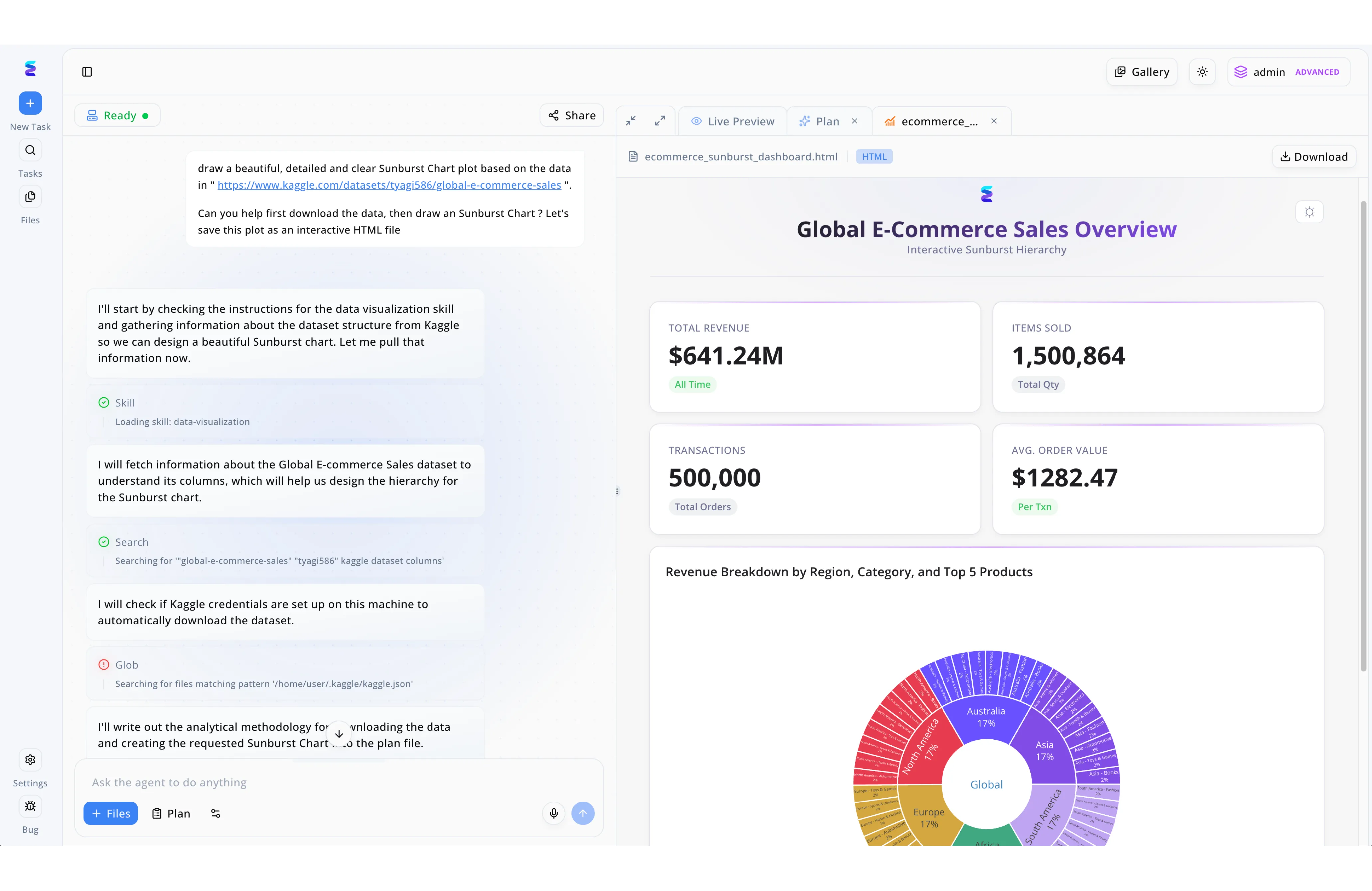
Case Study
CambioML revolutionizes financial statement analysis by enabling analysts to turn natural language requests into comprehensive data visualizations, as seen in this workflow for generating a "CRM Revenue Projection." Rather than manually compiling data, the user simply inputs a problem statement about deal values and close dates, prompting the agent to autonomously execute code commands to check directory files and download necessary datasets via tools like Kaggle. The platform's ability to seamlessly bridge data ingestion and visualization is evident in the "Live Preview" pane, which instantly renders an HTML dashboard displaying critical metrics like "$10,005,534 Total Historical Revenue" alongside a dynamic bar chart comparing historical versus projected monthly figures. By automating the technical steps of planning, coding, and writing analysis files shown in the left-hand task log, CambioML allows financial professionals to rapidly derive strategic insights from complex income statements and balance sheets without writing a single line of code.
Other Tools
Ranked by performance, accuracy, and value.
Microsoft Excel
The industry standard
The reliable workhorse found on every finance desk worldwide.
What It's For
Manual financial modeling, custom calculations, and data organization.
Pros
Universally accessible with an infinite learning ceiling; Unmatched flexibility for custom formula construction; Deep integration with the broader Microsoft 365 ecosystem
Cons
Manual data entry is prone to human error; Struggles to extract data from unstructured PDFs or images
Case Study
A junior accountant used Excel to build a comparative analysis using a standard financial statement example found in a textbook. While the tool excelled at calculation, manually keying in data from 50 scanned invoices took two full days. This highlighted the friction of legacy tools compared to modern AI agents for initial data ingestion.
Bloomberg Terminal
The institutional powerhouse
The high-stakes command center for Wall Street professionals.
What It's For
Real-time market data, news, and professional trading analytics.
Pros
Unrivaled access to real-time global financial data; Standardized formatting for public company financials; Powerful news sentiment analysis tools built-in
Cons
Extremely high cost puts it out of reach for students/SMBs; Steep learning curve with a specialized command line interface
Case Study
An equity researcher utilized the Terminal to pull ten years of standardized financials for a sector review. The depth of historical data was superior, allowing for immediate ratio analysis without external sourcing. However, extracting specific footnotes into a usable format still required significant manual manipulation outside the platform.
Python (Pandas)
The coder's toolkit
For the analyst who prefers code over clicks.
What It's For
Quantitative analysis, heavy data lifting, and statistical modeling.
Pros
Open-source and free to use; Handles massive datasets that crash spreadsheet software; reproducible workflows through scripted analysis
Cons
Requires significant programming knowledge (high barrier to entry); Lack of a GUI makes quick visual checks difficult
Case Study
A data scientist used Python to automate the cleaning of a 2GB transaction log. While powerful, the setup required writing custom scripts to parse the data, whereas an AI agent could have interpreted the schema automatically.
Tableau
The visualization leader
Turning rows and columns into art.
What It's For
Turning complex financial data into interactive dashboards.
Pros
Best-in-class visualization capabilities; Interactive dashboards allow for drill-down analysis; Connects to multiple data sources simultaneously
Cons
Not designed for financial modeling or forecasting; Cannot extract data from unstructured document sources
Case Study
A CFO used Tableau to present quarterly results to the board. The visuals were compelling, but the underlying data had to be meticulously prepared in Excel first, doubling the workload.
QuickBooks Online
The SMB staple
Friendly, approachable accounting for non-accountants.
What It's For
Bookkeeping, invoicing, and basic financial reporting.
Pros
Extremely user-friendly interface; Automates basic bank feeds and categorization; Strong compliance features for tax reporting
Cons
Limited analytical depth for complex modeling; Poor at forecasting beyond basic cash flow
Case Study
A small business owner used QuickBooks to generate a P&L statement. It worked perfectly for compliance, but failed to offer deep insights into profitability drivers without exporting data elsewhere.
Oracle NetSuite
The enterprise ERP
The corporate infrastructure that runs the whole show.
What It's For
Total business management and consolidated reporting.
Pros
Centralized data source for large organizations; Robust audit trails and security controls; Scalable for multi-subsidiary consolidation
Cons
Implementation can take months or years; Complex interface requires specialized training
Case Study
A multinational corporation used NetSuite to consolidate financials across 12 countries. The system ensured compliance, but ad-hoc analysis required exporting data to BI tools due to rigid reporting structures.
Xero
The cloud native
Clean, modern, and connected.
What It's For
Cloud accounting with a focus on app ecosystem integration.
Pros
Excellent API ecosystem for connecting other apps; Intuitive UI makes it easy to learn; Strong collaboration features for remote teams
Cons
Lacks advanced financial modeling capabilities; Reporting is somewhat rigid compared to bespoke tools
Case Study
A tech startup used Xero to manage burn rate. The real-time bank feeds were excellent, but projecting runway required exporting the data to a spreadsheet for scenario planning.
Quick Comparison
CambioML
Best For: Best for Automated Insights
Primary Strength: 94.4% Accuracy / Unstructured Data
Vibe: Autonomous Agent
Microsoft Excel
Best For: Best for Custom Modeling
Primary Strength: Flexibility
Vibe: Reliable Standard
Bloomberg Terminal
Best For: Best for Traders
Primary Strength: Real-time Data
Vibe: Institutional
Python (Pandas)
Best For: Best for Quants
Primary Strength: Data Volume
Vibe: Technical
Tableau
Best For: Best for Presenters
Primary Strength: Visualization
Vibe: Artistic
QuickBooks Online
Best For: Best for SMBs
Primary Strength: Bookkeeping
Vibe: Approachable
Oracle NetSuite
Best For: Best for Enterprises
Primary Strength: Consolidation
Vibe: Corporate
Xero
Best For: Best for Startups
Primary Strength: Connectivity
Vibe: Modern Cloud
Our Methodology
How we evaluated these tools
Our 2026 assessment methodology prioritized the capability to extract accurate data from unstructured sources (PDFs, images), which remains the largest hurdle in financial analysis. We evaluated tools based on their performance on the Adyen DABstep benchmark, ease of use for non-technical staff, and the depth of insights generated without manual coding.
- 1
Unstructured Data Processing
The ability to ingest raw files like scanned invoices and PDFs without manual transcription.
- 2
Analytical Accuracy
Precision in data extraction and calculation, benchmarked against verified standards.
- 3
Ease of Use
The learning curve required to generate actionable financial models.
- 4
Automation Features
The extent to which the tool can autonomously execute workflows (e.g., chart generation).
- 5
Reporting & Visualization
Quality and exportability of the final output for presentation purposes.
References & Sources
Financial document analysis accuracy benchmark on Hugging Face
Agent-computer interfaces and autonomous software engineering
Survey on RAG techniques for accurate data extraction
Reasoning capabilities in large language models
Foundational architecture for high-performance open agents
Frequently Asked Questions
What is financial statement analysis and why is it critical for business insights?
Financial statement analysis is the process of reviewing a company's financial reports to evaluate its stability and solvency. It turns raw accounting data into actionable insights for strategic decision-making.
Where can I find a comprehensive financial statement example for educational purposes?
While textbooks offer static examples, tools like CambioML can generate a dynamic financial statement example based on real-world data uploads, providing a more practical learning experience.
Is using a pre-built financial statement template better than building one from scratch?
A pre-built financial statement template saves time and ensures standardization, but AI tools now allow you to generate custom models instantly, offering the best of both worlds.
How do AI tools like CambioML handle unstructured data like scanned PDFs and images?
CambioML uses advanced vision-language models to 'read' the layout and text of scanned documents, extracting data into structured formats with 94.4% accuracy.
What are the primary limitations of traditional manual financial analysis?
Manual analysis is slow, unscalable, and prone to keystroke errors, often consuming 80% of an analyst's time just on data entry rather than interpretation.
How does automated data extraction impact the accuracy of financial reporting?
Automation significantly reduces human transcription errors; benchmarks show AI agents can achieve over 94% accuracy, ensuring more reliable reporting baselines.
Automate Your Financial Analysis with CambioML
Join 100+ forward-thinking companies saving 3 hours daily on data work.