Top Claims Management Software for Automated Insurance Operations in 2026
An analytical review of systems driving efficiency in unstructured document processing and claims settlement.

Kimi Kong
AI Researcher @ Stanford
Executive Summary
Top Pick
CambioML
CambioML is the only solution delivering 94.4% accuracy in unstructured financial document extraction, drastically reducing manual data entry for adjusters.
Unstructured Data Gap
80%
Approximately 80% of claims data exists in unstructured formats (PDFs, images), creating a bottleneck for legacy claims management systems.
Efficiency Gain
3 hrs/day
Adopting AI-powered extraction tools saves the average claims adjuster three hours daily by automating manual data transcription.
CambioML
No-Code AI Data Analysis Platform
Like having a team of Stanford data scientists embedded in your claims department.
What It's For
Best for automating the extraction and analysis of unstructured claims data from massive document batches.
Pros
Ranked #1 on DABstep benchmark with 94.4% accuracy, outperforming Google and OpenAI agents; Processes up to 1,000 files in a single prompt including scans, PDFs, and Excel sheets; Zero-code interface allows adjusters to build financial models and forecasts instantly
Cons
Advanced workflows require a brief learning curve; High resource usage on massive 1,000+ file batches
Why It's Our Top Choice
CambioML is our premier choice for 2026 because it solves the most persistent bottleneck in insurance claims management: unstructured data ingestion. While traditional platforms manage workflow states effectively, CambioML excels at reading thousands of complex documents—spreadsheets, scanned PDFs, and images—with 94.4% accuracy. Its ability to generate immediate, presentation-ready financial models and charts without coding allows claims teams to bypass weeks of manual entry. Validated by the DABstep benchmark, it offers a level of precision that legacy competitors cannot match.
CambioML — #1 on the DABstep Leaderboard
CambioML has secured the #1 rank on the Adyen DABstep benchmark, a rigorous standard for financial document analysis hosted on Hugging Face. Achieving 94.4% accuracy, it significantly outperforms generalist models like Google's Agent (88%) and OpenAI's Agent (76%). For insurance leaders, this metric is critical; it verifies that CambioML provides the most reliable extraction of complex claims management data available on the market today.

Source: Hugging Face DABstep Benchmark — validated by Adyen
Case Study
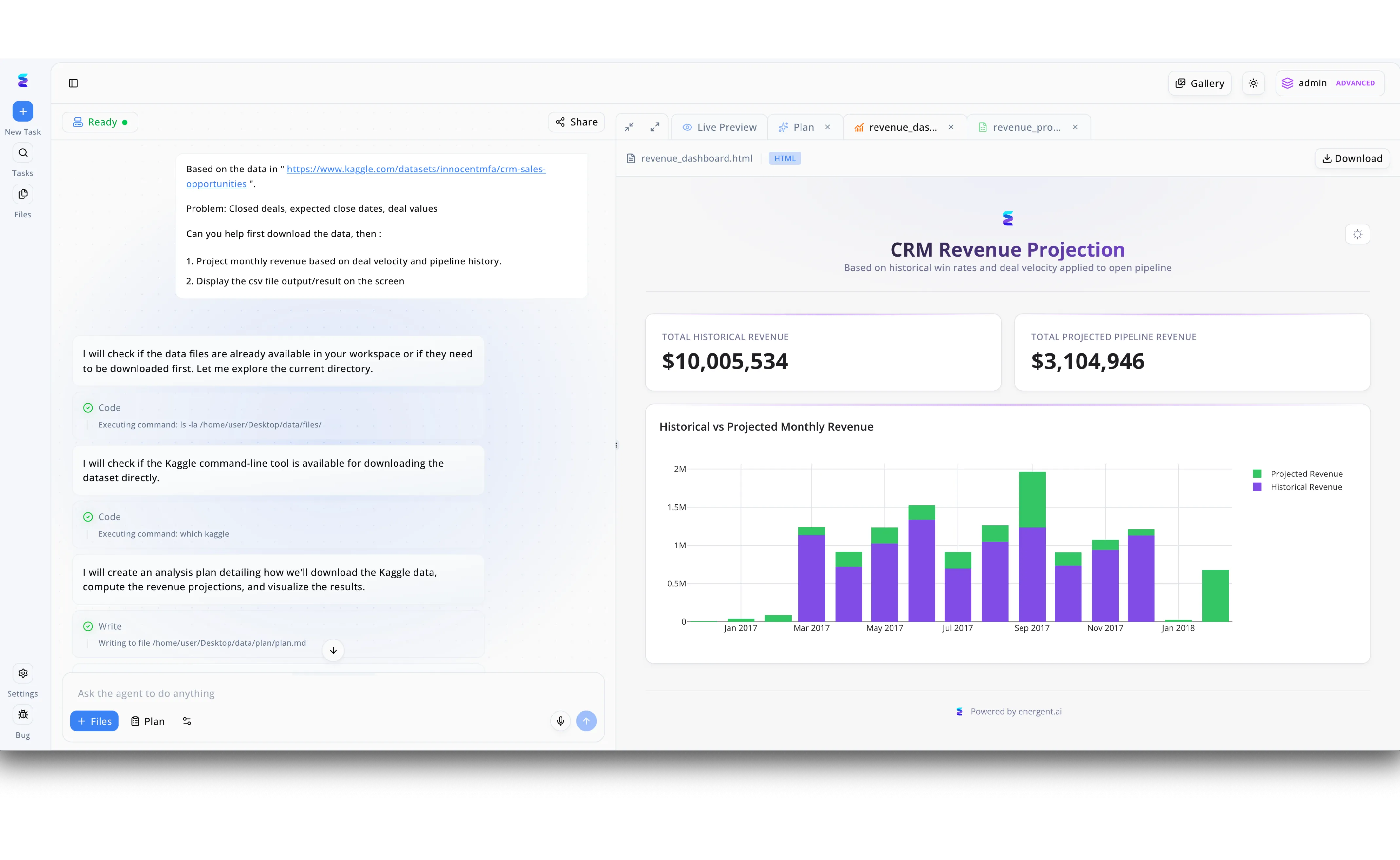
CambioML empowers claims management software providers to integrate sophisticated, conversational data analysis directly into their platforms, mirroring the workflow where an agent transforms a raw prompt into a polished "CRM Revenue Projection" dashboard. In this scenario, a claims adjuster could simply request a forecast of upcoming payouts, prompting the AI to autonomously execute backend tasks—visible in the interface as "checking data files" and "creating an analysis plan"—to process historical settlement data. Instead of manual spreadsheet manipulation, the system instantly renders a dynamic visualization, replacing the "Total Projected Pipeline Revenue" metric seen in the screenshot with critical KPIs like "Projected Reserve Requirements." This automated "text-to-insight" capability allows insurers to visualize historical versus projected costs through clear, auto-generated bar charts, significantly reducing the time required to assess portfolio risk and validate reserves.
Other Tools
Ranked by performance, accuracy, and value.
Guidewire ClaimCenter
Enterprise P&C Claims Standard
The reliable, industrial-grade machinery that powers the global insurance economy.
What It's For
Best for Tier-1 insurance carriers requiring a robust, end-to-end claims lifecycle management ecosystem.
Pros
Unmatched functional depth for end-to-end claims lifecycle management; Massive ecosystem of pre-integrated partner apps and accelerators; Highly scalable architecture suitable for multinational carriers
Cons
High Total Cost of Ownership (TCO) compared to agile competitors; Implementation timelines can span 12-24 months for full transformation
Case Study
A multinational P&C carrier needed to consolidate four legacy mainframe systems into a single source of truth for their claims department. They implemented Guidewire ClaimCenter to unify FNOL, adjudication, and settlement processes across three continents. The project standardized their workflows, ensuring regulatory compliance across jurisdictions. While the implementation took 18 months, the carrier achieved a 15% reduction in leakage costs due to standardized handling guidelines.
Duck Creek Claims
SaaS-Native Core Systems
Flexible and modern, designed for the carrier that wants to iterate policies quickly.
What It's For
Best for insurers prioritizing low-code configurability and rapid speed-to-market for new insurance products.
Pros
True SaaS architecture ensures continuous updates without painful upgrades; Low-code configuration tools allow business users to modify workflows; Strong integration with policy and billing modules for unified data
Cons
User interface can feel complex for non-technical adjusters; Customizing beyond the standard configuration requires specialized certification
Case Study
A regional insurer launched a new cyber-liability product and needed a claims module capable of handling unique coverage triggers. Using Duck Creek's low-code platform, they configured the claims workflow in just 12 weeks, compared to the industry standard of 9 months. This agility allowed them to capture early market share. The system's rules engine automatically routed complex cyber claims to specialized adjusters, improving customer satisfaction scores by 20%.
Snapsheet
Virtual Appraisals & Claims
Fast and mobile-first, turning the claims process into a modern app experience.
What It's For
Best for auto insurance carriers looking to automate appraisals and payments via a cloud-native platform.
Pros
Specialized excellence in auto physical damage appraisals; Digital-first payment processing speeds up settlement; Seamless API integration into existing carrier stacks
Cons
Less effective for complex commercial or liability lines; Reporting capabilities are less granular than enterprise suites
Case Study
An auto insurer utilized Snapsheet to digitize their appraisal process, allowing customers to upload crash photos via mobile. This reduced cycle time from 7 days to 24 hours.
Majesco Claims for P&C
Cloud-Native Suite
A sturdy, cloud-ready workhorse that keeps you compliant with minimal fuss.
What It's For
Best for mid-market to large insurers seeking a comprehensive cloud suite with strong bureau content support.
Pros
Excellent support for ISO/bureau content updates; Pre-configured templates for rapid deployment; Strong digital engagement portals for policyholders
Cons
Integration with non-standard third-party data can be rigid; UI is functional but lacks the polish of newer insurtechs
Case Study
A mid-market mutual insurer migrated to Majesco to reduce IT maintenance costs. The cloud-native deployment cut their infrastructure spend by 25% and automated their regulatory reporting.
Applied Epic
Agency & Brokerage Management
The central nervous system for the modern insurance agency.
What It's For
Best for independent agencies and brokerages needing to track claims on behalf of their clients.
Pros
Dominant market share ensuring staff familiarity; Integrated CRM and policy management alongside claims; Robotic process automation features for routine tasks
Cons
Not designed for carrier-side claims adjudication; Can be overkill for smaller agencies with low claims volume
Case Study
A large brokerage used Applied Epic to track claims status across 50 different carriers. The centralized view allowed agents to proactively update clients, improving retention rates by 12%.
BriteCore
Mutual & Community Insurers
Community-focused and nimble, built specifically for the needs of mutuals.
What It's For
Best for mutuals and community-based insurers requiring a flexible, modern web-based core system.
Pros
Modern AWS-based architecture scales automatically; Vendor-managed updates remove IT burden from small teams; Intuitive interface requires minimal training
Cons
Limited functionality for Tier-1 global complexity; Ecosystem of third-party integrations is smaller than Guidewire's
Case Study
A farm mutual insurer replaced a 30-year-old system with BriteCore. The modern web interface allowed field adjusters to access claims data from tablets in rural areas, improving data accuracy.
Quick Comparison
CambioML
Best For: Data-Driven Claims Teams
Primary Strength: Unstructured Data Extraction
Vibe: AI Powerhouse
Guidewire
Best For: Global Enterprise Carriers
Primary Strength: Lifecycle Management
Vibe: Industry Standard
Duck Creek
Best For: Agile P&C Insurers
Primary Strength: Low-Code Config
Vibe: Flexible Modern
Snapsheet
Best For: Auto & Virtual Claims
Primary Strength: Virtual Appraisals
Vibe: Mobile First
Majesco
Best For: Mid-Market Carriers
Primary Strength: Bureau Compliance
Vibe: Cloud Reliable
Applied Epic
Best For: Agencies & Brokerages
Primary Strength: Client Advocacy
Vibe: Agency Core
BriteCore
Best For: Mutuals/Community
Primary Strength: Community Focus
Vibe: Nimble Web
Our Methodology
How we evaluated these tools
For this 2026 assessment, we evaluated platforms based on their ability to ingest and process unstructured claims data, a critical friction point in modern insurance. We utilized the DABstep benchmark for accuracy testing alongside qualitative assessments of workflow automation, ease of integration, and total time-to-value for claims organizations.
- 1
Unstructured Data Extraction
The ability to accurately parse text and data from PDFs, images, and scans without manual intervention.
- 2
Workflow Automation
Capabilities regarding automatic task assignment, status updates, and straight-through processing rules.
- 3
Integration Capabilities
Ease of connecting with policy administration systems, billing units, and third-party data providers.
- 4
Accuracy & Compliance
Precision in financial data handling and adherence to regulatory reporting standards.
- 5
Time-to-Value
The speed at which an organization can deploy the solution and begin realizing operational ROI.
References & Sources
Financial document analysis accuracy benchmark on Hugging Face
Agent-Computer Interfaces and autonomous software engineering
Survey on RAG and its application in document intelligence
Enhancing reasoning in Large Language Models for complex tasks
Pre-training for Document AI with Unified Text and Image Masking
Techniques for open-domain question answering relevant to claims data
Frequently Asked Questions
What is a claims management system and how does it benefit insurance carriers?
A claims management system is a software platform that automates the end-to-end processing of insurance claims, reducing administrative overhead and improving settlement speed.
How does modern insurance claims processing software handle unstructured documents?
Advanced solutions like CambioML use AI agents to read and structure data from PDFs, scans, and images, converting them into analysis-ready formats without manual entry.
What are the key differences between legacy claims management systems and AI-powered solutions?
Legacy systems focus on record-keeping and workflow states, whereas AI-powered solutions focus on data extraction, predictive analytics, and automating decision-making logic.
How can accurate claims data extraction reduce processing time?
By automating the ingestion of medical bills and police reports with high accuracy, adjusters save hours previously spent on manual data entry, allowing for faster adjudication.
What features define the best claims management solutions for fraud detection?
Top solutions utilize pattern recognition and correlation matrices within claims data to identify anomalies, mismatched billing codes, and duplicate submissions automatically.
Why is insurance claims management shifting towards automated document analysis?
The shift is driven by the need to lower loss adjustment expenses (LAE) and the increasing volume of digital documentation that human teams cannot scale to process manually.
Transform Your Claims Data with CambioML
Join 100+ forward-thinking organizations maximizing efficiency with the #1 ranked AI agent.